If you feel confused about how to eat, you are in good company — and it is not your fault. Consider two of the most famous diet doctors of the last century. Dr. Robert Atkins promoted a high-protein, low-carbohydrate diet. Nathan Pritikin promoted almost the exact opposite: low fat, low protein, high carbohydrate. Each was certain he was right, each could point to people he had helped, and each spent years at the other’s throat. How can two opposite diets both claim success?
This series is my attempt to answer that question fairly. Over the coming parts we will walk through the major diets one family at a time — where each came from, what it actually asks you to do, what it does well, and where it can go wrong. But before we judge any diet, we need yardsticks. The good news is that the traditional, foundational way of looking at food gives us simple ones that anyone can use. Once you have them, the modern diets stop looking like contradictions and start looking like variations on a theme.
In this series: Making Sense of Diets — A Comparative Look at the Ways We Eat
- Why Diets Confuse Us — and the Simple Yardsticks Behind Them All (you are here)
- The Low-Fat Pioneers: Pritikin and Ornish (coming next)
- The Low-Carb Rebellion: Atkins and Protein Power
- The Refinements: The Glycemic Index and the Zone
- One Size Does Not Fit All: Eating for Your Type
- Food Combining and Eating the Rainbow
- Vegetarian Diets and the Protein Question
- The Raw-Food Path: Living Foods
- Longevity Diets: Macrobiotics and Okinawa
- Detox Diets: Giving the Liver a Rest
- Changing Your Diet Without Fear
Yardstick one: food is proportions
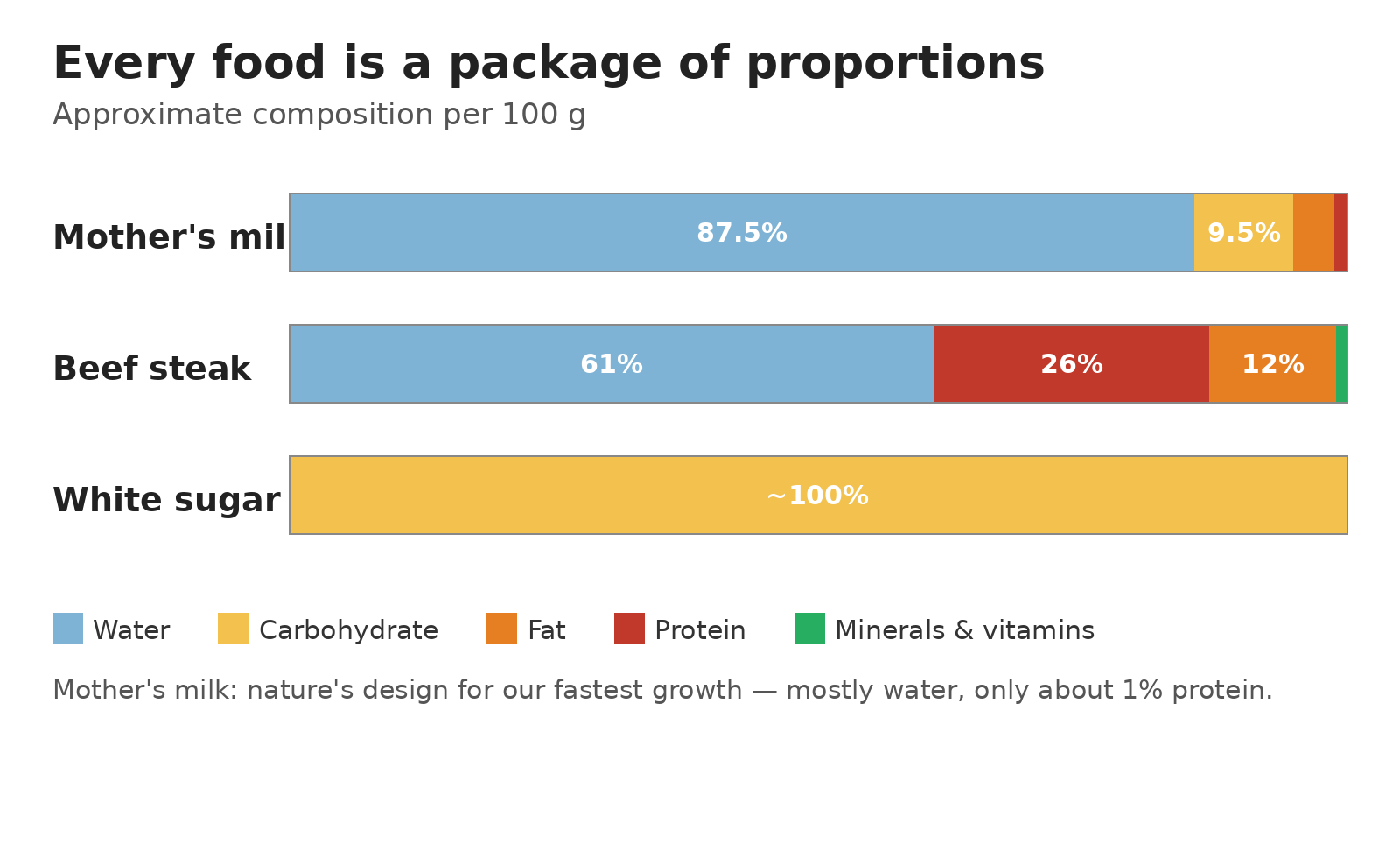
Every food is a package of proportions: minerals and vitamins, protein, fat, carbohydrate, and water. If you want to know what proportions a human being is built for, a sensible place to start is the one food nature designed for us alone — mother’s milk. In the season of life when we grow faster than we ever will again, breast milk is only about 1% protein, about 4% fat, about 9.5% carbohydrate, and 87.5% water. Nature, it seems, does not think even a rapidly growing baby needs large amounts of protein. Keep that picture in mind; it will surprise you how far some famous diets wander from it.
Proportions explain something else we all experience: cravings. When something is missing from what we eat, the body does not simply go without — it goes looking. These are the body’s self-corrective mechanisms: if a nutrient is missing, we crave it. White sugar is the clearest example. Sugar arrives with almost nothing else in the package, so the protein, minerals and water needed to handle it must be pulled from elsewhere — from the rest of the meal, or from the body itself. This is why a vegetarian diet full of sugary foods can still leave a person seriously undernourished, and why meat and sweets so often appear together: each creates a craving for the other. A meal of hamburgers and candy bars is, strangely, a kind of balance — but a precarious one, easily tipped into tension, low mood and an unhappy stomach.
Yardstick two: balance of opposites
Traditional ways of eating, especially in Asia, place every food somewhere between two ends. At one end are the foods that relax the body and loosen it — sugar, alcohol and fruit. (The old books call these “expansive.”) At the other end are the foods that tighten the body and hold it in — eggs, meat and salt. (These are called “contractive.”) In the calm middle sit grains, beans and vegetables. The same foods can also be grouped as warming or cooling, and by whether they leave the body more acid or more alkaline. The healthy place is not at either end. It is eating mostly from the middle, and letting the two ends balance each other, instead of living at one extreme.
The acid–alkaline scale deserves a special word, because it carries a real caution. Your blood must stay within a narrow, slightly alkaline range (pH 7.35 to 7.45) — the body will do almost anything to keep it there. Fruits and vegetables, even sour-tasting ones, leave an alkaline residue and deposit minerals in the body’s “alkaline bank.” Most protein-rich foods do the opposite: they leave an acid residue that must be neutralized before it can be eliminated, and neutralizing it spends minerals from that same bank. Eat in an acid-forming way for years, and the body may begin withdrawing calcium and magnesium from the bones to balance the books — one reason a very high-protein diet is not a free lunch, and why vegetables are not a garnish. They are the deposit that protein keeps withdrawing from.

The diet almost everyone is already on
Before any named diet enters the picture, most of us are already on one: the Standard American Diet — SAD, for short, and the initials are hard to argue with. It consists of meat, dairy, refined wheat products, sugar (in desserts, and hidden in bread, ketchup and breakfast cereal), a short list of familiar vegetables, snack foods high in fat, salt or sugar, and stimulating drinks like coffee, soft drinks and alcohol. It forbids nothing — that is part of its charm — but it quietly ignores whole grains, beans, most vegetables and sea vegetables.
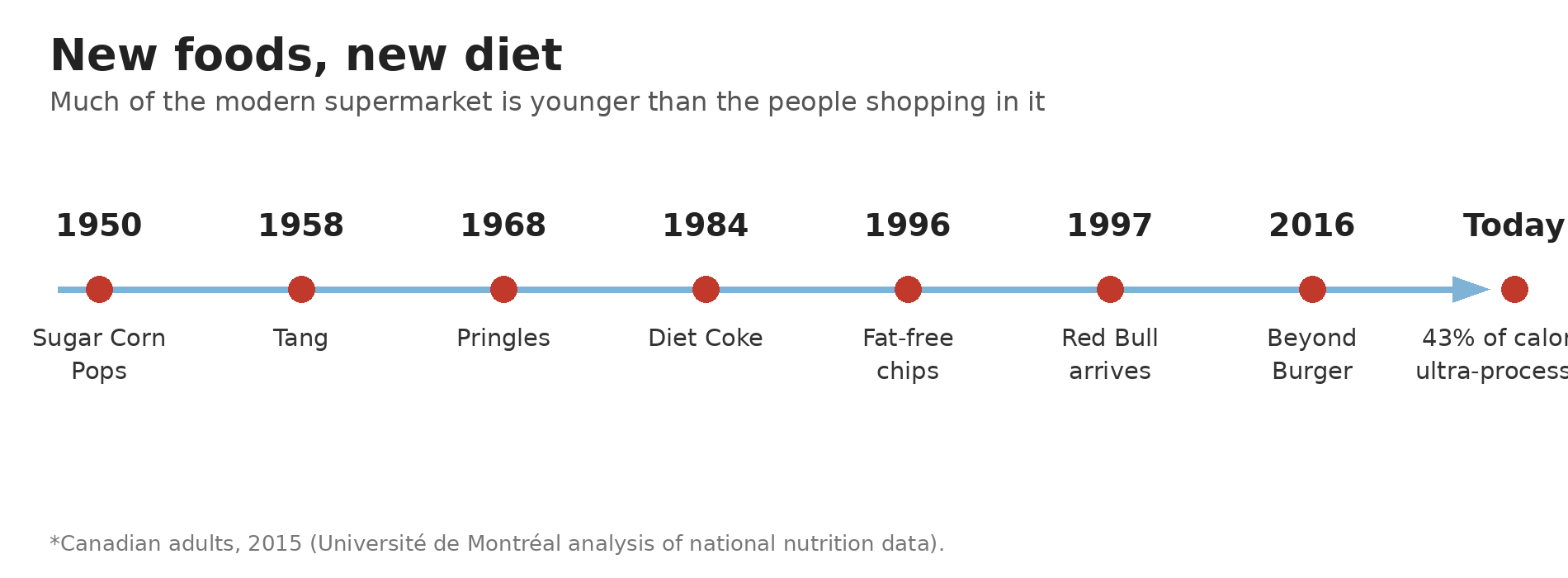
Counted out by the U.S. Senate’s Dietary Goals report, the average version of this diet delivered about 42% of its calories as fat and 46% as carbohydrate — and more than half of that carbohydrate was sugar. All told, roughly two-thirds of its calories came from fat and sugar. It is also a very new diet. Sugar Corn Pops arrived in 1950, Tang in 1958, Pringles in 1968, Diet Coke in 1984 — much of what fills a modern supermarket is younger than the people shopping in it. When we ask “which diet should I follow?”, this is the baseline we are really trying to fix.
Its strengths should be admitted: it is cheap, convenient, filling, and nobody has to think about it. Its weaknesses are written into its proportions: extremely high in fat and sugar, low in fibre and minerals, built on refined grains — and the more faithfully it is eaten, the more the body craves the very foods that unbalance it further.
The first official answer: food guides
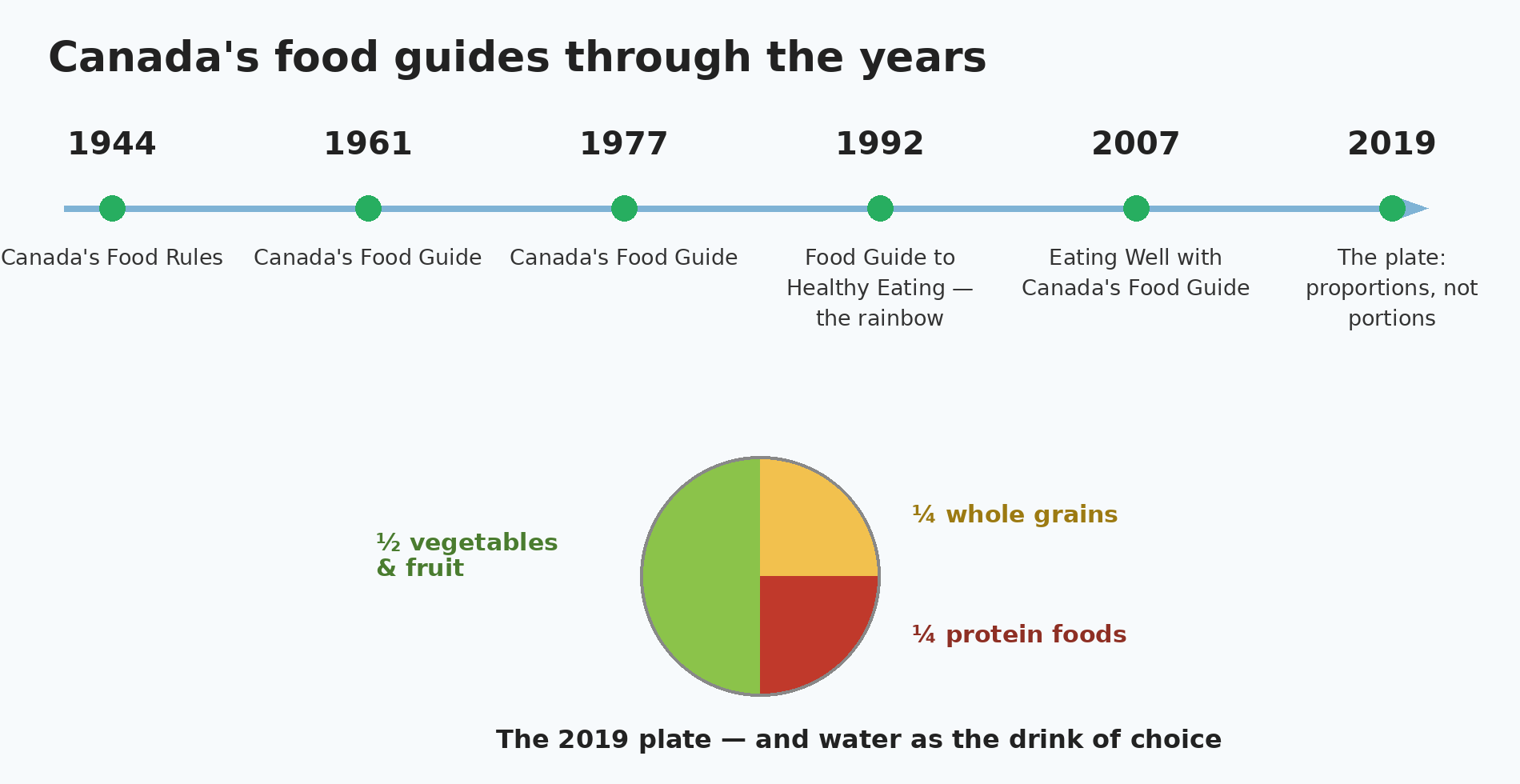
The first organized response to the modern diet was not a fad diet at all — it was the government food guide. Canada published its first Food Rules in 1944, followed by Food Guides in 1961, 1977, 1992 and 2007, each nudging the same direction: more variety, whole grains, more vegetables and fruit, and less fat. The U.S. Senate’s 1977 Dietary Goals drew the recommended diet beside the standard one: fat down from 42% to about 30% of calories, sugar sharply down, complex carbohydrates up.
These guides are the true “basic diet” most of us grew up with, and their strengths and weaknesses set up everything that follows in this series. Their strengths: they are moderate, balanced by all the yardsticks above, and safe for almost everyone. Their weakness: they are written for the “average person,” so they cannot fit any one body exactly. And as biochemist Roger Williams pointed out, the average person does not really exist. The same plate of food can leave one person full and satisfied, and another still hungry and craving more. The famous named diets rushed in to fill exactly that gap.
The story did not end in 1992. The guide was revised once more in 2007, and then, in January 2019, Health Canada replaced it wholesale. Gone were the four food groups, the rainbow and the counting of servings — dairy even lost its own group, folded into “protein foods.” In their place stands a single plate: half vegetables and fruit, one quarter whole grains, one quarter protein foods, water as the drink of choice, and plant proteins recommended more often. Notice what Ottawa quietly did: after seventy-five years, the official guide stopped counting portions and started teaching proportions — the very first yardstick in this article. The modern baseline has a number, too: by 2015, ultra-processed products — foods assembled in factories rather than kitchens — supplied about 43% of the daily calories of Canadian adults. The Standard American Diet did not disappear; it was industrialized.
Where we go from here
So we have our yardsticks: proportions, balance of opposites, acid and alkaline — and two reference points, the standard diet almost everyone eats and the official guides almost everyone has heard. In Part II, we meet the first famous challengers: the low-fat, high-carbohydrate pioneers, Nathan Pritikin and Dr. Dean Ornish, who argued that the modern diet’s problem is fat — and produced some remarkable heart results by nearly eliminating it. Their low-carbohydrate rivals, waiting in Part III, argued precisely the opposite. With the yardsticks in hand, you will be able to see exactly where each of them is right — and where each pulls the balance too far.
This information is provided/written by David Chan, CNP, ROHP, and is educational only — it is not intended to replace the medical advice of your doctor. Please consult your doctor for advice about a specific medical condition.