Part V ended with a question we can ask at every meal: how does this food work in me? This part asks two simpler questions about the plate itself. First: does it matter which foods sit together on the plate? Second: does it matter which colours are on it? One of these ideas comes with a strict chart of rules. The other comes with no rules at all — just a rainbow. Our yardsticks from Part I will help us judge both.
In this series: Making Sense of Diets — A Comparative Look at the Ways We Eat
- Why Diets Confuse Us — and the Simple Yardsticks Behind Them All
- The Low-Fat Pioneers: Pritikin and Ornish
- The Low-Carb Rebellion: Atkins and Protein Power
- The Refinements: The Glycemic Index and the Zone
- One Size Does Not Fit All: Eating for Your Type
- Food Combining and Eating the Rainbow (you are here)
- Vegetarian Diets and the Protein Question (coming next)
Food combining: one food at a time, please
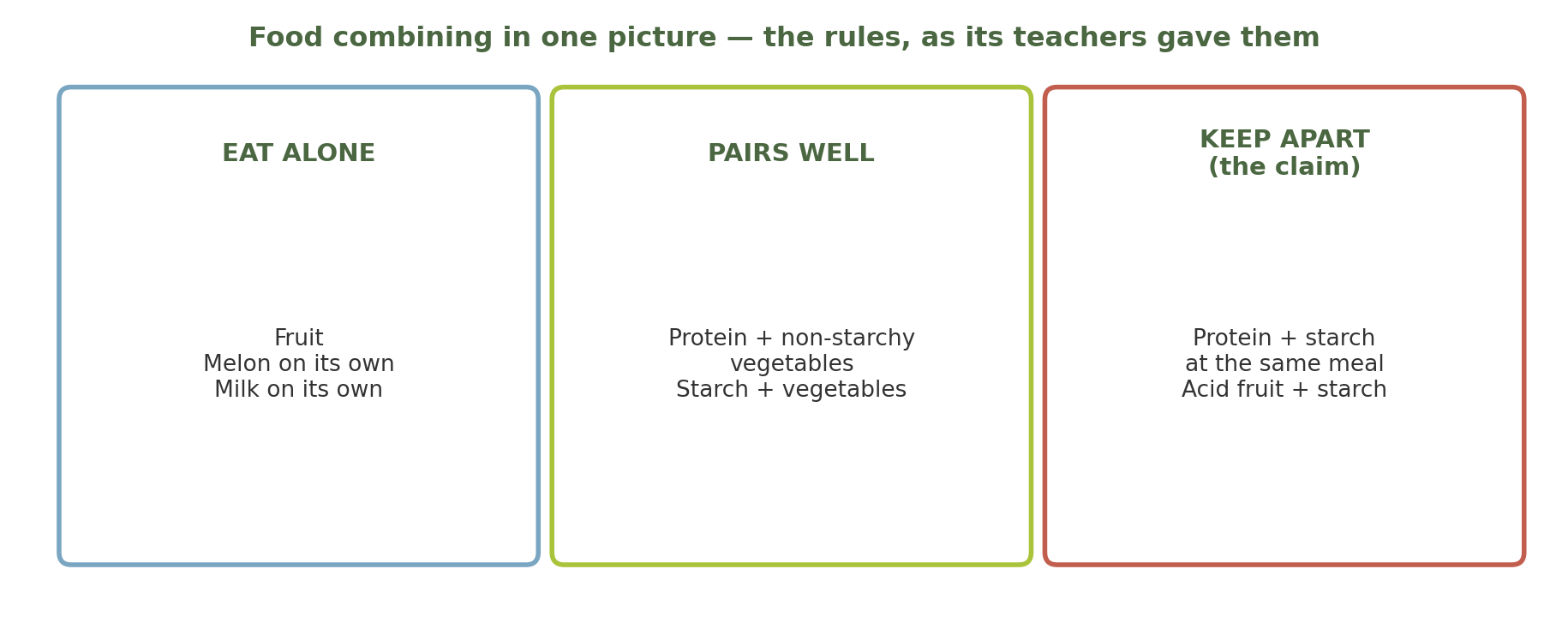
Food combining starts with a true fact about digestion. Your body uses different tools for different foods. Enzymes (the body’s worker proteins that break food down) each do one job: one breaks down protein, another breaks down starch, another breaks down fat. Protein digestion needs acid. Starch digestion starts best away from strong acid. From those two facts, the combining teachers built a full set of rules.
The rule most people know is this: do not eat concentrated protein and concentrated starch at the same meal. No meat with potatoes. No chicken with rice. Fruit is eaten alone, because it passes through the stomach fast and — so the claim goes — if it is held up behind a slow meal, it ferments (sours and makes gas) while it waits. Melon is eaten alone. Milk is drunk alone. Acid foods, like citrus and tomato, are kept away from starch. Vegetables are the peacemakers: they go with protein, and they go with starch, but protein and starch do not go with each other.
The picture behind the rules is easy to hold in your mind. Food leaves the stomach roughly in the order it arrived. So a badly combined meal leaves its last layers sitting and fermenting while the first layers move on. Follow the chart, the teachers said, and meals will feel lighter, gas and bloating will ease, and weight will fall because nothing is left half-digested.
Eating the rainbow: just add colour
The second idea in this part could not be more different. It gives you no chart of forbidden pairs. It asks one question: have you eaten every colour today?
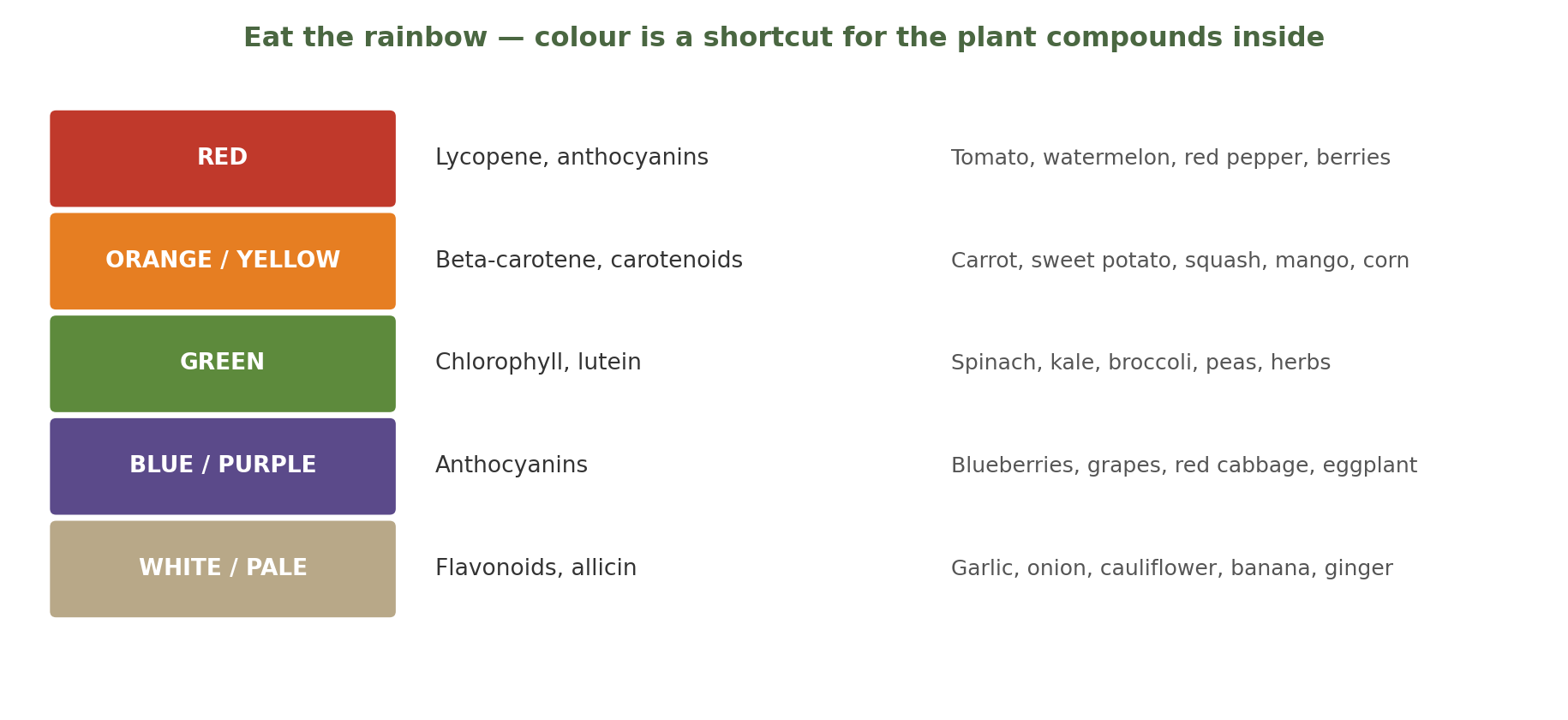
In the older colour-therapy teaching, each colour was linked to a mood, an organ and a list of foods. Red foods were for appetite and energy: beetroot, tomato, red pepper, red beans. Orange was for energy and digestion. Yellow was for cheerfulness. Green — the middle of the rainbow — was the balancing colour. Blue and purple were for calm, and a light blue-green evening meal was said to help sleep. You can leave the mood claims aside and still keep the useful core, because modern science found something real inside the colours.
The colour of a fruit or vegetable is not paint. In most cases, the colour is a plant compound. Red in a tomato is lycopene. Orange in a carrot is beta-carotene, which your body turns into vitamin A. Green in spinach is chlorophyll, travelling with lutein, which gathers in the eye. Blue and purple in berries and red cabbage are anthocyanins. Pale foods — garlic, onion, cauliflower — carry their own quieter compounds. Eat across the colours, and you eat across the compounds. That is the whole method: colour is a shortcut your eyes can use, so you do not need a chemistry book at the market.
Reading them by our yardsticks
Proportions first. Neither idea sets proportions, and here they part ways. Food combining can quietly wreck a plate’s proportions: if protein and starch can never meet, many sound meals disappear — beans with rice, lentils with bread, fish with potatoes — and the meals that remain can drift very low in energy, or very one-sided. The rainbow does the opposite. It changes nothing about how much you eat. It only widens what you eat, and a wider plate is usually a better-proportioned plate.
Balance of opposites. The rainbow is a balance tool by nature: it pushes you away from a plate of one colour — the beige plate of the standard diet in Part I — toward the full spread. Food combining aims at a different kind of balance, inside the stomach. Its wish is kind: do not ask the body to do two opposite jobs at once. The wish is easy to understand. Whether the body needs that help is the test below.
Acid and alkaline. Combining rules borrow some acid–alkaline language: acid fruit with starch is said to stop starch digestion. But the stomach is strongly acid on purpose, and it adjusts its acid to the meal in front of it. The rainbow, meanwhile, quietly fills the alkaline bank from Part I: most of its foods are the fruits and vegetables that leave an alkaline residue and deposit minerals. No chart needed — colour does the work.
The balanced criticism, in one place, is this. Food combining takes one true fact — each enzyme does one job — and stretches it too far. In a healthy body, the enzymes do not take turns and they do not cancel each other out. The stomach makes acid and protein enzymes together; the small intestine adds starch and fat enzymes a step later; and most foods are mixtures already — milk, beans and bread each carry protein, starch and fat in one food. Strict combining can also cost more than it gives: meals become hard to share, eating out becomes a worry, and some people grow anxious about normal mixed meals that never harmed them. None of that denies a real experience: many people do feel lighter on combining-style meals. But smaller meals, less fat at one sitting, and slower eating — all common side effects of the rules — explain that lighter feeling at least as well as the chart does.
Where they stand today
Food combining has been tested once, in a fair fight. Fifty-four adults ate the same low calorie level for six weeks. One group kept protein and starch apart. The other ate ordinary balanced meals. Both groups lost weight — the combining group about 6.2 kilos, the balanced group about 7.5 kilos — and the difference was not significant. Blood sugar, cholesterol, insulin and body fat moved the same way in both. The chart added work. It did not add results.
The rainbow has been checked on a much larger scale, and the honest answer has two halves. The strong half: people who eat more fruit and vegetables live longer, on average, in study after study. In the largest recent count — 26 studies and close to 1.9 million people — the lowest death rates sat at about five servings a day, two of fruit and three of vegetables. Variety adds its own clue: people who ate more than 30 different plants a week had richer, more diverse gut microbes than people who ate 10 or fewer, and a diverse gut is linked to better health. And when reviewers gathered all the studies on the colour pigments themselves — 86 studies, more than 37 million people — about four in ten outcomes were better with higher intakes. The careful half: most of those pigment ratings were graded low or very low in certainty. Colourful food is linked to health. No single colour is a medicine, and no pigment pill has earned the rainbow’s place.
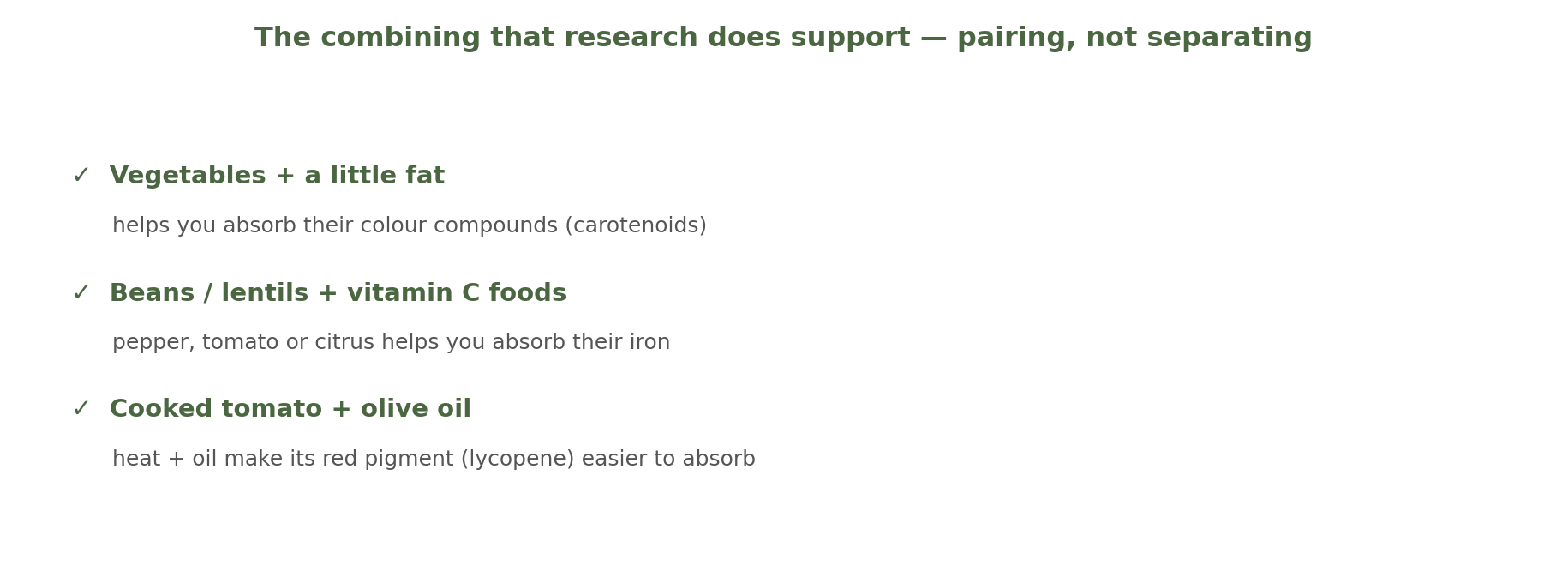
One more finding deserves its own line, because it turns food combining on its head. The combining that research does support is pairing, not separating. Eat a little fat with your vegetables — olive oil on the salad, avocado beside the carrots — and your body absorbs far more of their colour compounds; with no fat at all, it absorbs almost none. Eat beans or lentils with a vitamin C food — peppers, tomatoes, a squeeze of citrus — and your body absorbs more of their iron. Cooked tomato with olive oil gives up more of its red lycopene than raw tomato alone. The body, it turns out, does not want its foods kept apart. It wants them to help each other across the plate.
So keep the two ideas in their right sizes. Food combining is a tidy theory that the body, tested fairly, did not need — hold its chart lightly, and keep any part of it that simply helps you eat smaller, slower meals. The rainbow is the opposite kind of idea: no theory to defend, just a habit your eyes can check in one glance at the plate. Of the two, it is the one that has grown stronger with every new study. Have you eaten every colour today? is a question a child can ask — and, so far, science is happy with the answer it leads to.
Where we go from here
In Part VII we take up the oldest question in this series: can a plate with no meat on it give you enough protein? Vegetarian diets come in many forms, and the protein answer — grains and beans completing each other — is one of the most practical lessons in these pages.
This information is provided/written by David Chan, CNP, ROHP, and is educational only — it is not intended to replace the medical advice of your doctor. Please consult your doctor for advice about a specific medical condition.