Part IV ended with a quiet fact. The same slice of bread can raise one person’s blood sugar sharply and barely move another’s. If that is true — and it is — then a diet built for the “average person” is built for nobody in particular. The writers in this part took that thought to its end. Do not fit the person to the diet, they said. Fit the diet to the person: to your build, your glands, your metabolic speed (how fast your body burns its fuel), even your blood. It is the most human idea in this series. It is also the one that needs our yardsticks most.
In this series: Making Sense of Diets — A Comparative Look at the Ways We Eat
- Why Diets Confuse Us — and the Simple Yardsticks Behind Them All
- The Low-Fat Pioneers: Pritikin and Ornish
- The Low-Carb Rebellion: Atkins and Protein Power
- The Refinements: The Glycemic Index and the Zone
- One Size Does Not Fit All: Eating for Your Type (you are here)
- Food Combining and Eating the Rainbow
- Vegetarian Diets and the Protein Question (coming next)
The oldest idea in the series
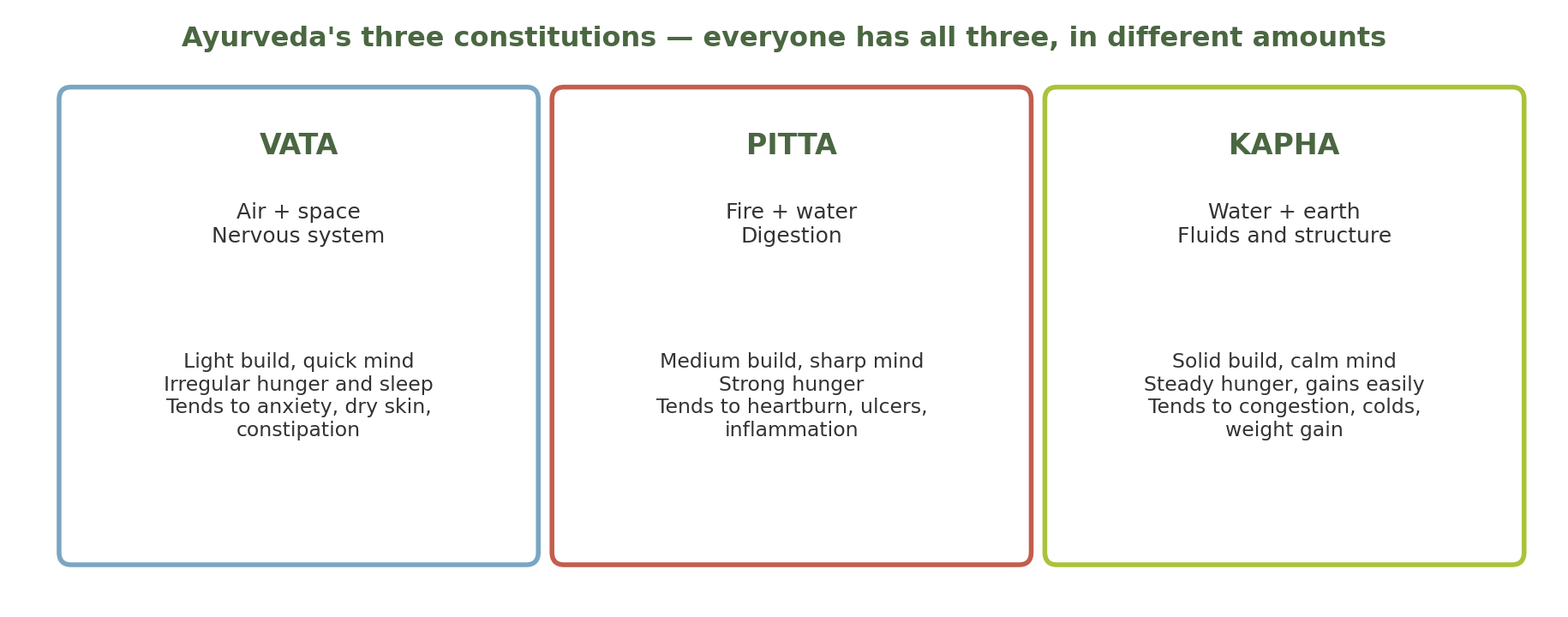
Fitting food to the person is not new. It is very old. In India, Ayurveda (the traditional system of health from India, more than 5,000 years old) teaches that every body is a mix of three constitutions. Vata governs the nervous system: light build, quick mind, irregular hunger and sleep, a tendency to anxiety, dry skin and constipation. Pitta governs digestion: medium build, sharp mind, strong hunger, a tendency to heartburn and inflammation. Kapha governs fluids and structure: solid build, calm mind, a tendency to congestion and easy weight gain. Nobody is one type only. The point is which one leads — and food and routine are then chosen to calm it.
China built a sister idea. In the five phases, foods, seasons, colours and flavours are linked to the organs: spring, green and sour for the liver; late summer, yellow-orange and sweet for the stomach and spleen; autumn, white and spicy for the lungs; winter, dark and salty for the kidneys; summer, red and bitter for the heart. The message is the same in both lands: watch the person first, then choose the food. The modern typing diets are this old idea, dressed in lab coats.
Metabolic typing: fast burners and slow burners
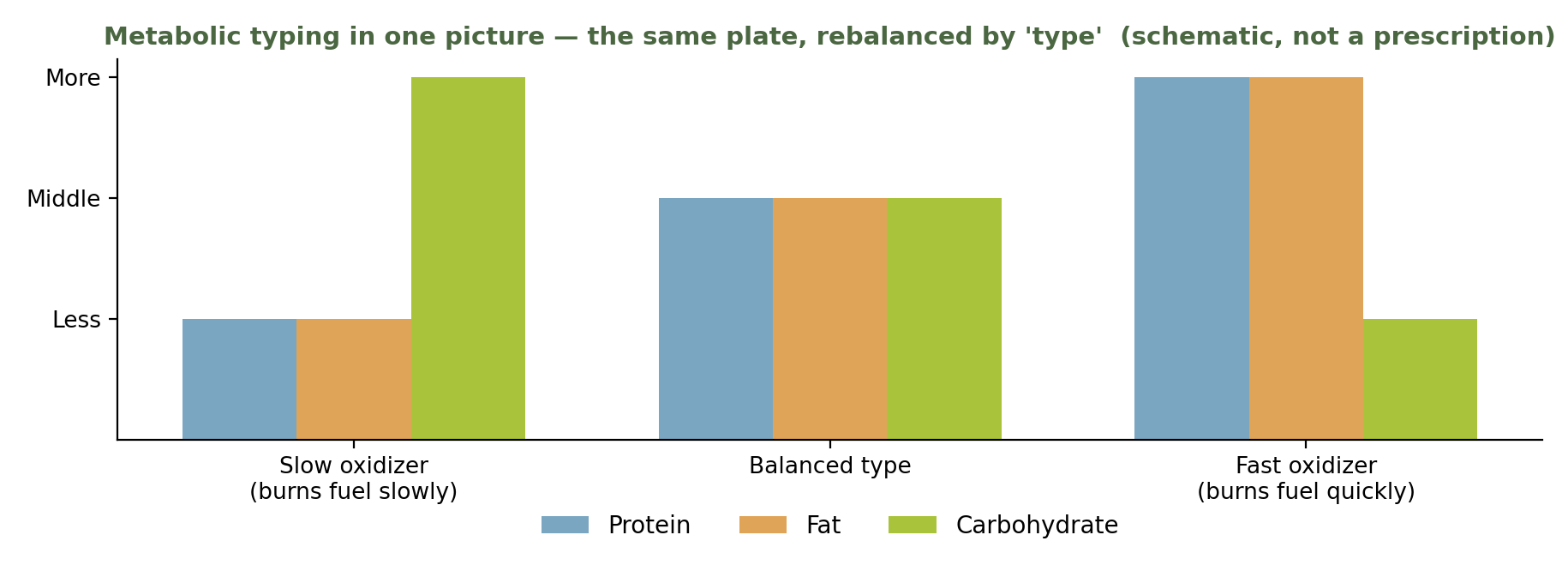
The best-known modern form came from William Wolcott, in The Metabolic Typing Diet (2000). His starting point was the food fight from Parts II and III. Pritikin and Atkins could both point to people they had helped, he argued, because they were treating different people. Some bodies burn fuel fast (fast oxidizers — the old name for people said to turn food into energy quickly) and do best with more protein and fat, which burn slow and steady. Some burn fuel slowly (slow oxidizers) and do best with more carbohydrate. In between sits a balanced type. A long questionnaire — about appetite, cravings, energy, sleep and mood — sorts you, and the plate is rebuilt around you.
This idea explains, in one move, why your friend thrives on a diet that leaves you tired and hungry. And it makes a testable promise: match the plate to the type, and people should do better than on a mismatched plate. Hold that promise in mind. We will check it below.
Body typing: the gland that leads
Elliot Abravanel, a doctor, sorted people by shape instead. In his plan, one gland (a small organ that makes hormones, the body’s chemical messengers) is said to lead in each person, and it shows in where weight is carried and what is craved. His four types were drawn for women. The pituitary type carries weight evenly. The thyroid type is long and narrow, gains in the middle, and craves sweets and caffeine. The adrenal type is solid, gains above the waist, and craves salty, fatty food. The gonadal type gains at the hips and thighs, and craves creamy, spicy food. Each type gets its own food plan, built to rest the leading gland and wake up the quieter ones.
There is a plain truth inside this: bodies really do store fat in different places, and cravings really do differ. Whether one gland is truly the cause is another question — and, again, it can be tested.
Blood type: the hunter, the farmer, the nomad
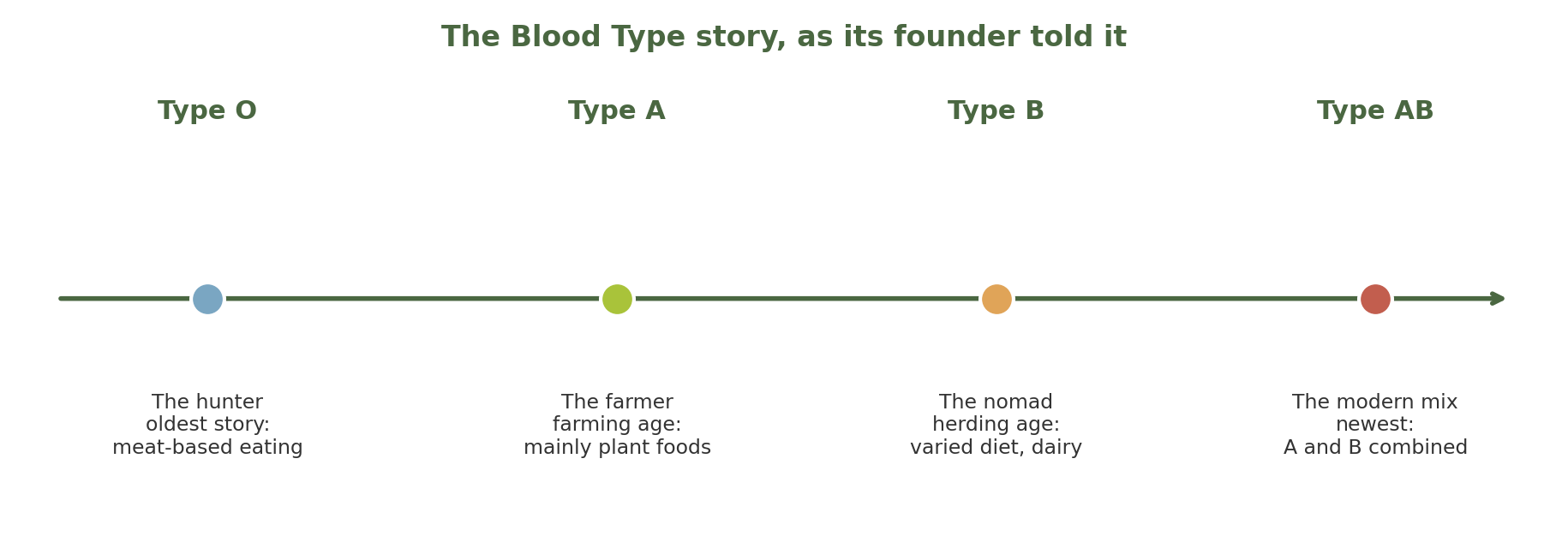
The most famous typing diet of all sorts people by something you can measure in a lab: your blood. Peter D’Adamo’s Eat Right 4 Your Type (1996) told an evolution story. Type O came first, in hunters, and still suits a meat-based diet. Type A came with farming, and suits mainly plant foods. Type B came with nomadic herders, and suits a varied diet with dairy. Type AB, the newest mix, sits between A and B. His mechanism was lectins (natural proteins in foods that can bind to cells): eat lectins that clash with your blood type, he argued, and they can clump your blood cells and make you ill. Each type got long lists of foods to eat and to avoid.
It is easy to see why this book sold in the millions. Your blood type is real, fixed and personal. A diet keyed to it feels like a key cut for your own lock. This system also makes the clearest promise of all — and clear promises are the easiest to test.
Reading them by our yardsticks
Proportions first. A typing system, by itself, says nothing about proportions — and that is both its freedom and its risk. Two people of the same “type” can build very different plates from the same list, one balanced and one lopsided. The Type O pattern, read strictly, can become the rebels’ plate from Part III, with the same strengths and the same acid load; the Type A pattern can become a sound plant-based plate, or a sugary vegetarian one — and Part I warned that a sugary vegetarian diet can still leave a person short of real nourishment. The type does not save the plate. The plate still has to be built well.
Balance of opposites. Here the old roots shine. Ayurveda and the five phases are, at heart, balance systems: find the end you lean toward, then eat and live a little toward the other end. That is our second yardstick, stated 5,000 years early. The modern systems are weaker here, because a fixed type can freeze into a fixed plate — the same foods in every season and at every age — while the old teachers changed the advice with the season and the person.
Acid and alkaline. No typing system was built on this yardstick, so each plate has to be checked on its own. A meat-heavy type plan needs its pile of vegetables just as much as Atkins did. A plant-based plan starts with the alkaline bank full, but still needs enough protein, and the minerals protein metabolism spends. Type is a starting point for building a plate. It is never a substitute for building it.
The balanced criticism, in one place, is this. Types are tidier than people. A questionnaire sorts you by how you feel this month, and feelings change with sleep, stress and age; body shape changes with the years too. And the strictest lists — above all the blood-type lists — cut out whole food groups for millions of people on the strength of a story, which can mean missing nutrients, hard family meals, and quiet guilt when the “right” diet for your type still does not work. None of that makes the core idea wrong. It means a type should be held lightly — a first guess to test against your own body, never an identity you must obey.

Where they stand today
Start with what is now solid: people differ, a lot, and we can measure it. When more than 1,000 adults ate identical meals in the PREDICT study, their blood-fat responses varied by about 103%, their blood-sugar responses by 68% and their insulin by 59%. Even identical twins often responded differently. The microbes in the gut helped predict the fat response better than the meal itself did, while genes predicted only a modest part. The individualists were right about the problem.
But when the famous typing systems were put to the test, the match itself failed. A systematic review found no study showing that eating for your blood type brings the claimed benefits. Then Toronto researchers did the fair test: in 1,455 adults, eating the Type A way was linked to better weight, blood pressure and blood fats — for people of every blood type. The diet helped. The matching added nothing. Gene typing fared no better: in DIETFITS, and again in the POINTS trial built for exactly this question, people on the diet their genes were said to favour lost no more weight than people on the “wrong” diet. For Ayurveda’s types, early gene research hints at some real biology, but no trial has yet shown that eating by your dosha (your constitutional type) beats eating well in general.
What has shown a small, real gain is a different kind of personal: not a fixed type, but your own measured response. In an 18-week trial, advice built from each person’s measured blood-sugar and blood-fat responses, gut microbes and health history beat standard advice on blood fats, with small gains in weight, waist and blood-sugar control beside it. That is the old idea, updated by sensors: do not guess the type. Measure the person, and adjust. The gain so far is modest — but unlike the types, it survived a fair test.
So this part ends with a split verdict, and the split is the lesson. “One size does not fit all” is true, and more proven today than when any of these books were written. The neat boxes — three constitutions, three burn rates, four glands, four blood types — have not been proven as the way to do the fitting. Keep the question they taught us to ask (how does this food work in me?), hold their answers lightly, and let your own body’s feedback — energy, hunger, sleep, digestion, and, where it matters, your lab results — have the last word.
Where we go from here
In Part VI we leave types behind and look at how foods are put together: food combining, which says what you eat together matters as much as what you eat — and the Rainbow diet, which asks a simpler question still: have you eaten every colour today?
This information is provided/written by David Chan, CNP, ROHP, and is educational only — it is not intended to replace the medical advice of your doctor. Please consult your doctor for advice about a specific medical condition.