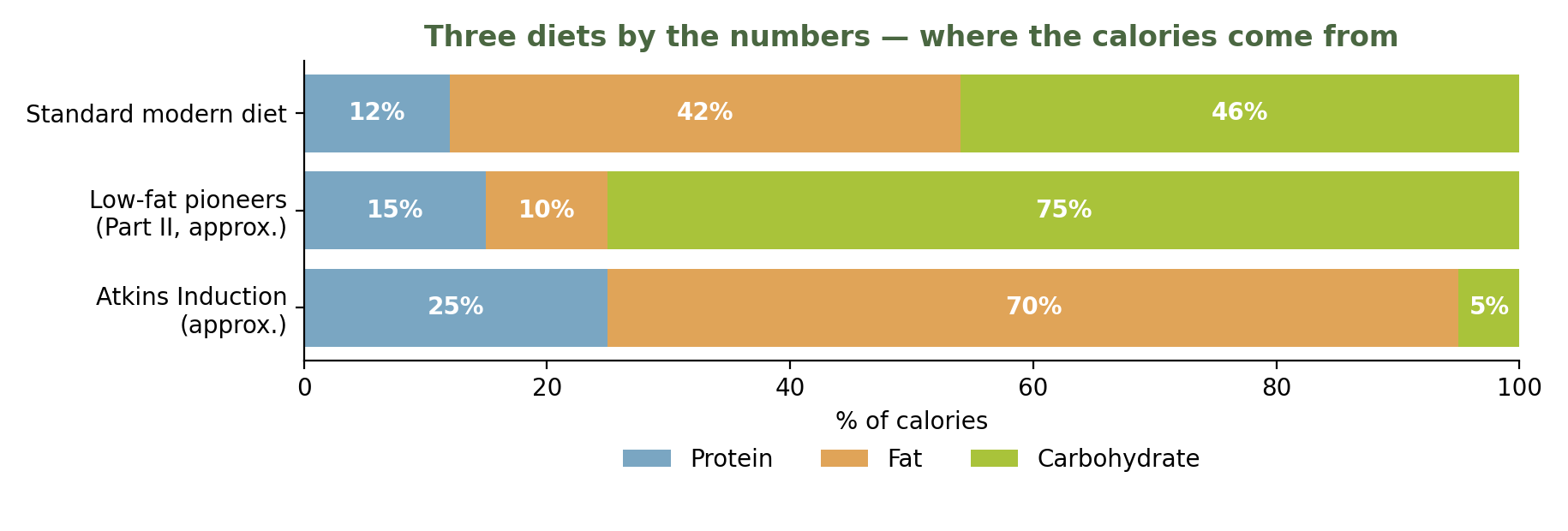
In Part II, the low-fat pioneers blamed fat. Take fat down to a tenth of your calories, they said, and the heart would begin to heal — and in supervised programs, it did. The rebels of this part looked at the same modern plate and blamed the opposite food. Fat was never the villain, they argued. Carbohydrate was — the bread, the pasta, the sugar. Cut carbohydrate hard, let protein and fat take its place, and the weight would fall off while you ate foods the low-fat camp had banned. It was one of the great food fights of the last fifty years. Our yardsticks from Part I let us watch it without taking sides.
In this series: Making Sense of Diets — A Comparative Look at the Ways We Eat
-
- Why Diets Confuse Us — and the Simple Yardsticks Behind Them All
- The Low-Fat Pioneers: Pritikin and Ornish
- The Low-Carb Rebellion: Atkins and Protein Power (you are here)
- The Refinements: The Glycemic Index and the Zone
- One Size Does Not Fit All: Eating for Your Type
- Food Combining and Eating the Rainbow
- Vegetarian Diets and the Protein Question (coming next)
The cardiologist who blamed bread
Dr. Robert Atkins was a heart doctor in New York. His book, first published in 1972, made a simple claim: people do not get fat mainly because they eat fat. They get fat because carbohydrate drives up insulin (the hormone that tells the body to store fuel), and a body with high insulin stores fat and craves more carbohydrate. Remove the carbohydrate, and the body has to burn its own fat instead.
His plan still runs in four steps today. In the first and strictest step, carbohydrate drops to about 20 grams a day — roughly what is in one apple — and most of even that small amount must come from green and non-starchy vegetables. Meat, fish, eggs, cheese, butter and cream are all allowed, and nobody counts calories. Then, week by week, carbohydrate is added back in small steps — a few more vegetables, then nuts and berries, then, for some people, fruit and grains — until each person finds the level where the weight stays off. That final level, held for life, is the real diet. The strict opening is only the doorway.
Protein Power: the same rebellion, with a calculator
A generation later, Drs. Michael and Mary Dan Eades, a husband-and-wife medical team, gave the rebellion a more careful form in Protein Power. Their starting point was the same hormone pair. Carbohydrate pushes insulin up fast and its partner hormone (glucagon — the one that releases stored fuel) down. Protein raises both a little. Fat, on its own, moves neither. So they built the plate protein first. Each day you eat enough protein for your body’s size and lean weight (your weight without the fat). Carbohydrate stays low, and fat fills the rest. They also stressed vegetables, fibre and food quality more than early Atkins did. Where popular Atkins could look like a licence for bacon and cream, Protein Power read more like an instruction book. Meet your protein need. Keep carbohydrate below the level that makes your insulin jump. And do not fear fat — but do not worship it either.
Why the first week looks like a miracle
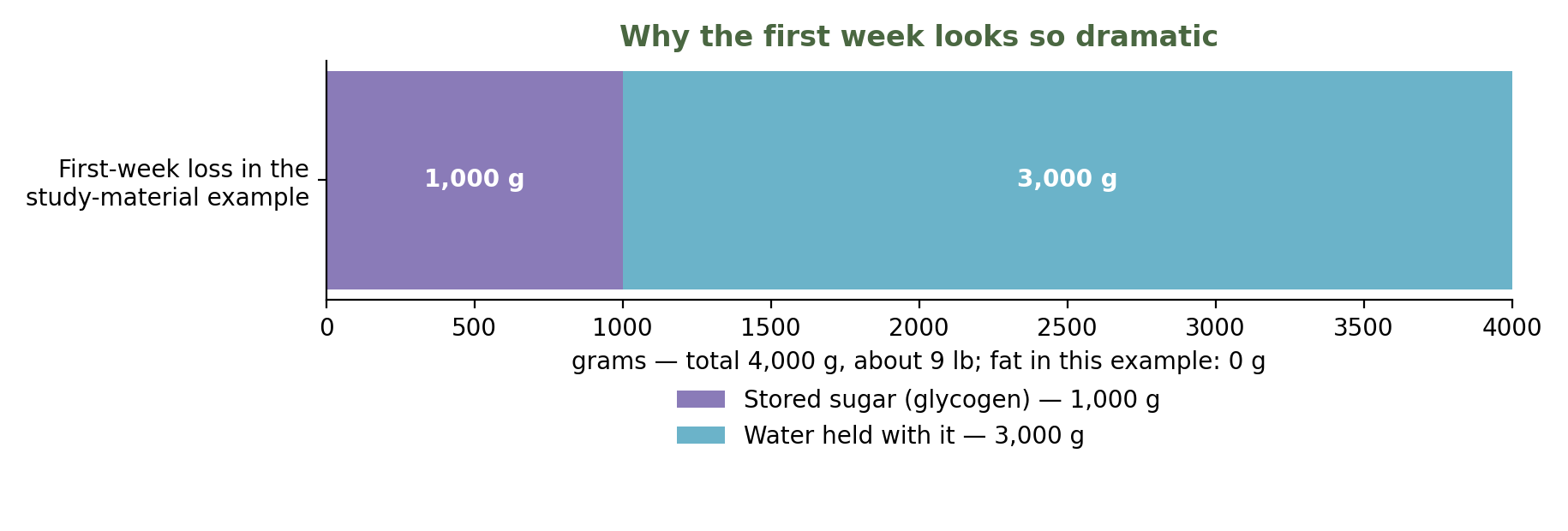
Both plans are famous for one thing above all: the first week. The scale can drop five, even nine or ten pounds, and people understandably feel the diet is melting fat. Here our proportions yardstick earns its keep, because most of that first drop is not fat at all.
Your body stores carbohydrate in the muscles and liver, and it stores it wet — each gram of stored sugar holds about three grams of water with it. Cut carbohydrate hard, and within a day or two those stores are used up. Use up about 1,000 grams of stored sugar, and about 3,000 grams of water leave with it: about nine pounds on the scale, and not one gram of it fat. What happens next is real, but slower. With little carbohydrate coming in, the liver turns fat into a backup fuel (ketones — the old name for the fuel the brain can use when sugar runs short), hunger often goes quiet, and fat loss begins in earnest. Two honest warnings belong here. First, when carbohydrate returns, the stores refill and the water returns with them — which is why the “lost” pounds seem to reappear over one weekend. Second, that quiet hunger is borrowed, not owned: end the strict phase, and appetite usually comes back with it.
A softer cousin: the Reward Meal
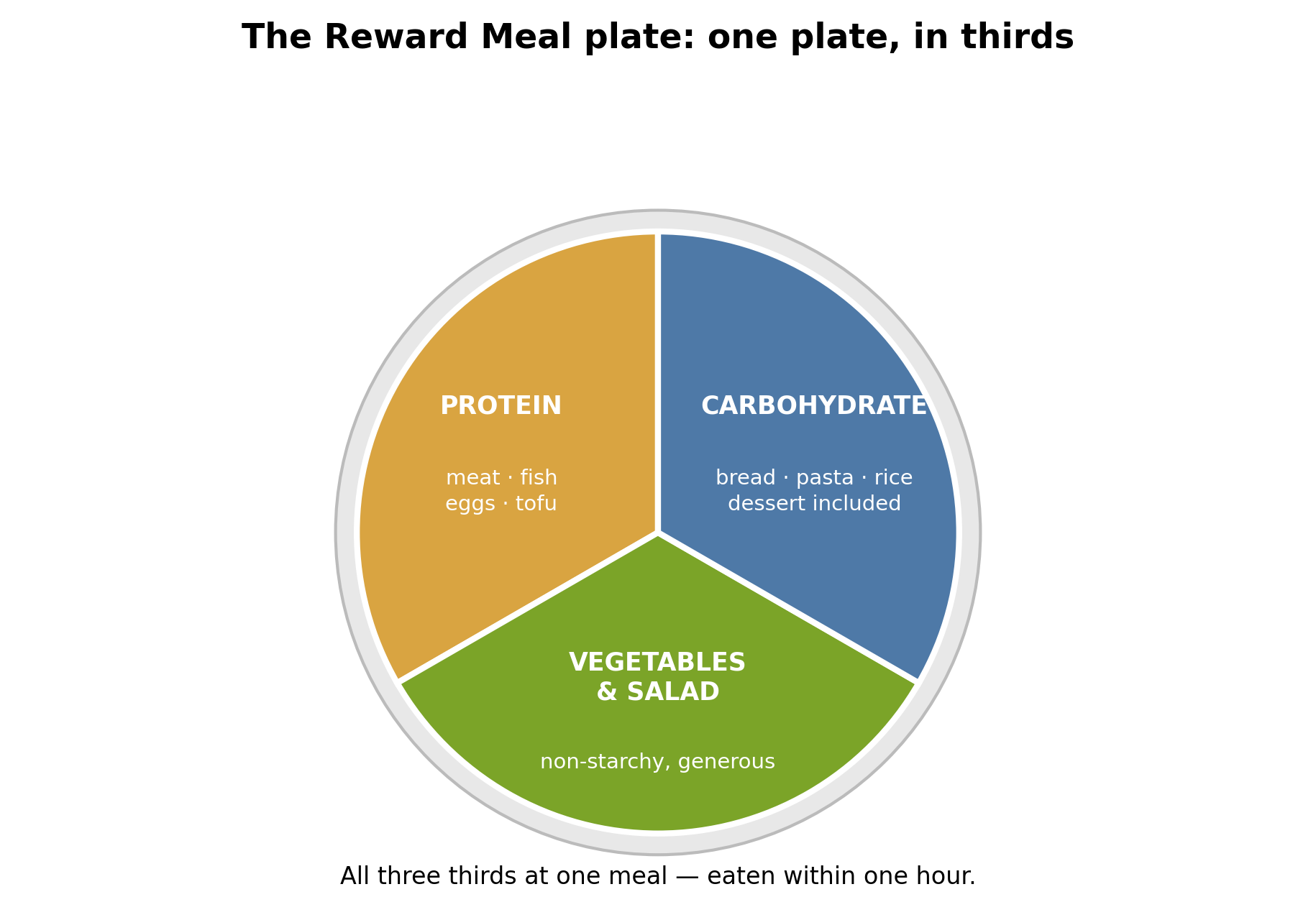
Not every low-carb plan demanded a life without bread. Drs. Rachael and Richard Heller argued that some people release too much insulin after eating carbohydrate. They also get too little of the calming brain signal (serotonin) that should say “enough.” So for them, cravings are chemistry, not weak will. Their Carbohydrate Addict’s Diet answered with timing instead of total bans. Two meals a day are low-carbohydrate. Then comes one daily Reward Meal: a plate in thirds — protein, vegetables or salad, and any carbohydrate foods you like, dessert included. The whole meal is eaten within one hour, so the insulin rise comes once and ends. It was the first sign that the rebellion itself would start refining its one hard rule. Part IV is the story of those refinements.
Reading them by our yardsticks
Proportions first. The rebels fixed one real fault of the modern diet: sugar and refined starch all but disappear, and with them the empty package that forces the body to go looking for missing nutrients, as we saw in Part I. But the package that replaces it is lopsided the other way. Protein and fat rise far above the proportions in mother’s milk, nature’s own reference food. Meanwhile fibre falls low — and so do the minerals and plant chemicals that ride in grains, beans and fruit — unless the dieter works hard at vegetables. The plan’s own rule tells the story: eight to ten glasses of water a day are not a suggestion on these diets, because a heavy protein load needs that water to clear its waste.
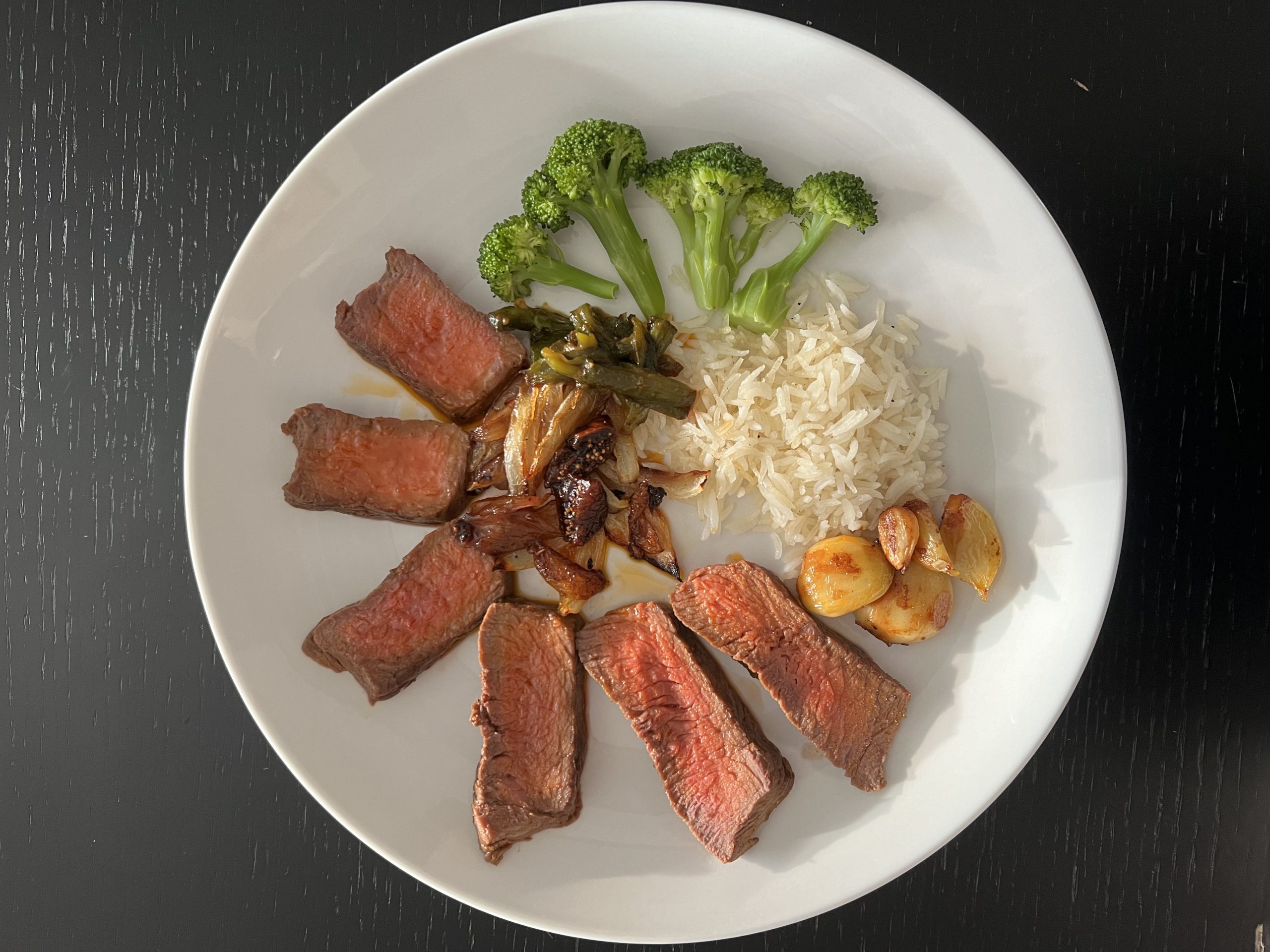
Balance of opposites. Meat, eggs and cheese sit at the tightening, warming end of our scale — the end opposite the pioneers’ garden plate. Eaten with generous green vegetables, the meal can still find a middle. Eaten as meat and fat alone, it lives at one extreme, and Part I’s warning applies in mirror image. A body fed at one end starts craving the other. That is one reason the call of bread and sweets, when it returns, can be so strong.
Acid and alkaline. Here is the rebels’ weakest yardstick. Protein-rich foods leave an acid residue, and the minerals to balance it must come from somewhere — from vegetables, if the plate holds enough of them, or from the body’s own alkaline bank if it does not. A low-carb plate built on meat and a large pile of green vegetables answers this fairly well. A plate of meat, cheese and cream, with lettuce as decoration, does not.
The balanced criticism, in one place, is this. These diets can be hard on the body when they are done carelessly, or kept at their strictest level for a long time. The risks named most often are kidney stones, gout and gallstones. Some people’s LDL cholesterol (the “bad” cholesterol) rises, even while their triglycerides (another blood fat) fall. And anyone with diabetes who takes insulin or certain blood-sugar pills must have their doses reviewed before cutting carbohydrate, because blood sugar can fall too low. One class of newer diabetes drugs also needs careful watching on a very-low-carb diet, because of a rare but serious build-up of acid in the blood. None of that erases what the rebels got right. It does mean this is a diet to do with your doctor in the room, not a dare.
Where they stand today
Half a century on, the great food fight has ended in something close to a draw — and the draw itself is the lesson. Researchers ran the two camps head to head for a full year, in a careful trial of 609 adults. Healthy low-fat and healthy low-carb eaters lost almost the same weight. And neither genes nor insulin levels could say in advance who would do better on which diet. Across 121 trials, Atkins stood near the front for weight lost at six months — and, like almost every diet studied, most of that edge had faded by twelve months. What has held up best is narrower and more useful. For people with type 2 diabetes, eating less carbohydrate improves blood-sugar control in the short term. It helps enough that Diabetes Canada now lists low- and very-low-carbohydrate eating as a real option, with the medication cautions above. The rebels were right that carbohydrate — above all sugar and refined starch — was doing more harm than the low-fat years admitted. They were wrong that it was the only lever. Our yardsticks said that from the start: pull any one lever to its limit, and something else quietly bends.
Where we go from here
The next generation refused to choose a camp. If carbohydrate is the problem, they asked, is it all carbohydrate — or only the fast kind? And if hormones rule the plate, can a meal be built to keep them balanced instead of swinging? In Part IV we meet the refinements. One is the Glycemic Index, which ranks carbohydrate foods by how fast they raise blood sugar. It holds some surprises — a baked potato can raise blood sugar faster than sugar itself. The other is Barry Sears’ Zone, which keeps every food and argues about the ratio instead. The rebellion, in other words, grows up.
This information is provided/written by David Chan, CNP, ROHP, and is educational only — it is not intended to replace the medical advice of your doctor. Please consult your doctor for advice about a specific medical condition.