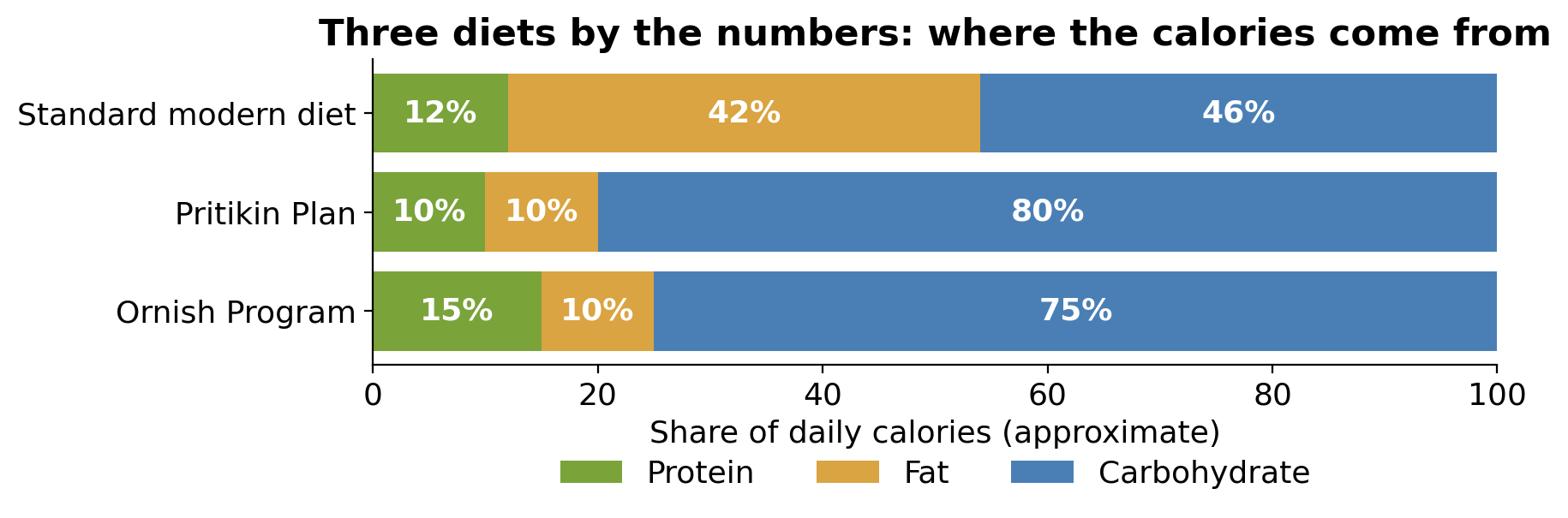
In Part I, we built our yardsticks and met the diet almost everyone is already on — the standard modern diet, with about 42% of its calories coming from fat. The first famous challengers stared at that number and reached a bold conclusion: fat is the problem. Take fat almost entirely away, they said, and the body’s troubles — clogged arteries above all — would begin to heal. Two men carried this idea further than anyone else. One of them was not a doctor at all. The other was a young doctor who asked a question his profession considered already settled.
In this series: Making Sense of Diets — A Comparative Look at the Ways We Eat
-
-
- Why Diets Confuse Us — and the Simple Yardsticks Behind Them All
- The Low-Fat Pioneers: Pritikin and Ornish (you are here)
- The Low-Carb Rebellion: Atkins and Protein Power
- The Refinements: The Glycemic Index and the Zone
- One Size Does Not Fit All: Eating for Your Type
- Food Combining and Eating the Rainbow
- Vegetarian Diets and the Protein Question (coming next)
-
The engineer who refused his diagnosis
Nathan Pritikin was an inventor and engineer, not a doctor. In his early forties, tests showed his cholesterol was high and his heart was already diseased. In those days, the standard advice was to rest, take medicine, and accept decline. Pritikin refused. He studied how people ate in parts of the world where heart disease was rare, changed his own eating step by step, and watched his own numbers fall. In the mid-1970s he opened the Pritikin Longevity Center in California, where guests came to live the program for weeks at a time, under doctors’ eyes.
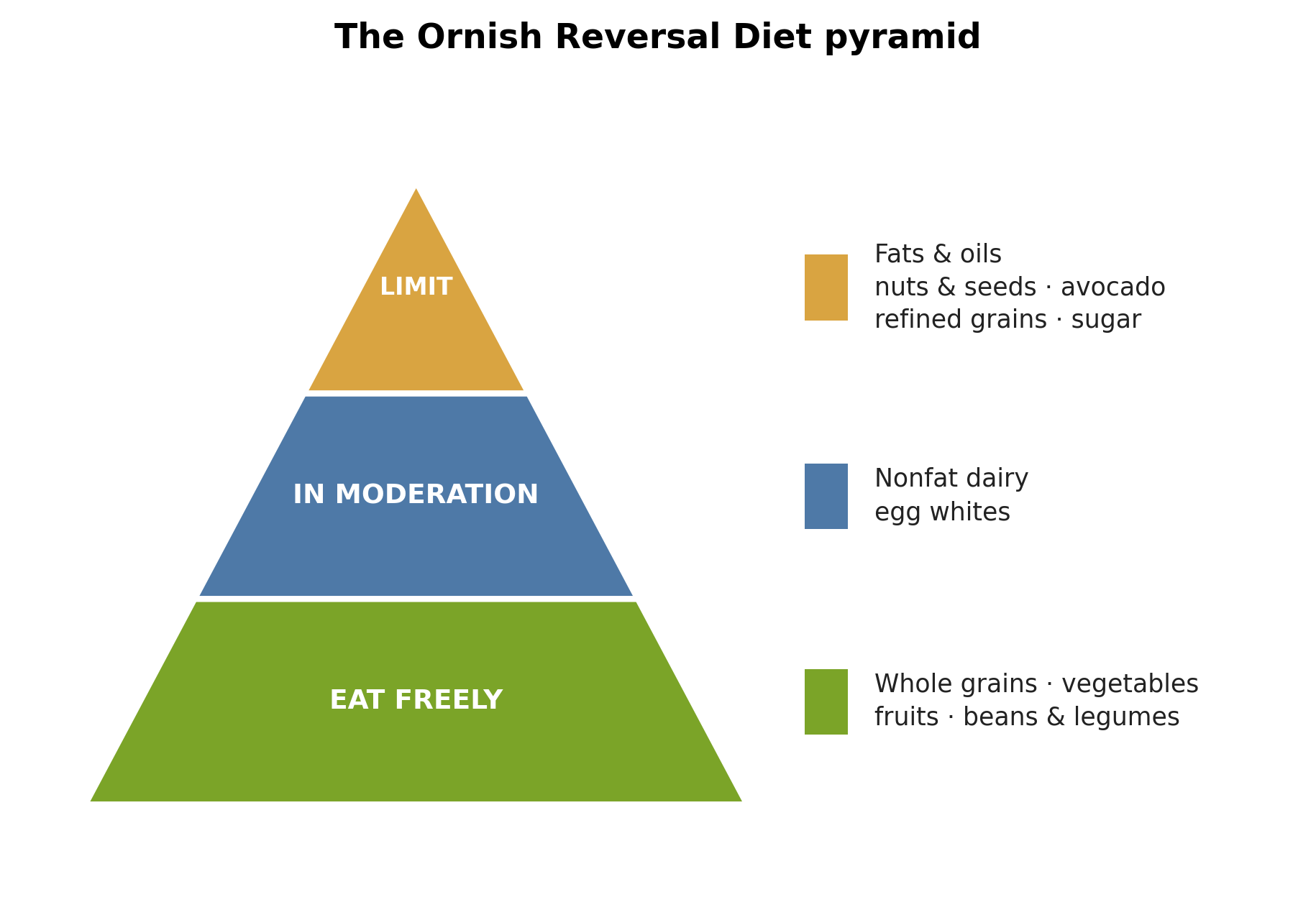
What did the program ask? Eat mostly plants, in their natural state: whole grains, vegetables, beans and fruit, in generous amounts — five or more servings a day of complex carbohydrates (starchy whole foods such as grains and beans), four of vegetables, three of fruit, and more if you are hungry. Keep fat under a tenth of all calories. Animal food shrinks to one small daily serving of lean meat, fish or poultry — about the size of your palm — plus a little nonfat dairy and egg whites if you wish. Off the table: all added oils and fats, even avocado and olives, salt, sugar and refined flour, caffeine, alcohol, and egg yolks. Daily exercise was part of the prescription, not an optional extra.
Pritikin never designed it as a weight-loss diet, but the weight fell anyway — about 13 pounds in the first month, on average. The blood numbers moved just as fast: in that first month, cholesterol commonly dropped from about 235 to 175, and triglycerides (another blood fat) from about 174 to 130. Results like that, repeated in person after person, are why a program many people dismissed as too strict could not simply be ignored.
The doctor who asked whether arteries could heal
Dr. Dean Ornish, a young cardiologist (heart doctor), took the same low-fat idea and asked a harder question. Pritikin had shown the risk numbers improving. Could the disease inside the arteries themselves actually go backwards — without drugs, and without surgery?
His program kept a very-low-fat vegetarian diet much like Pritikin’s. Fat was again about a tenth of calories. The food was built on grains, vegetables, fruit, beans, egg whites and nonfat dairy. But Ornish added three more parts, because he held that the heart is more than a pump. One part was stress management: an hour a day of breathing, stretching and meditation. One part was exercise: at least half an hour a day, walking above all. And one part was group support. He believed loneliness itself burdens the heart, and that people heal better connected than alone. His team’s rule was plain: the patients who reversed their disease did the whole program — and the more closely a person followed all four parts, the more their arteries improved.
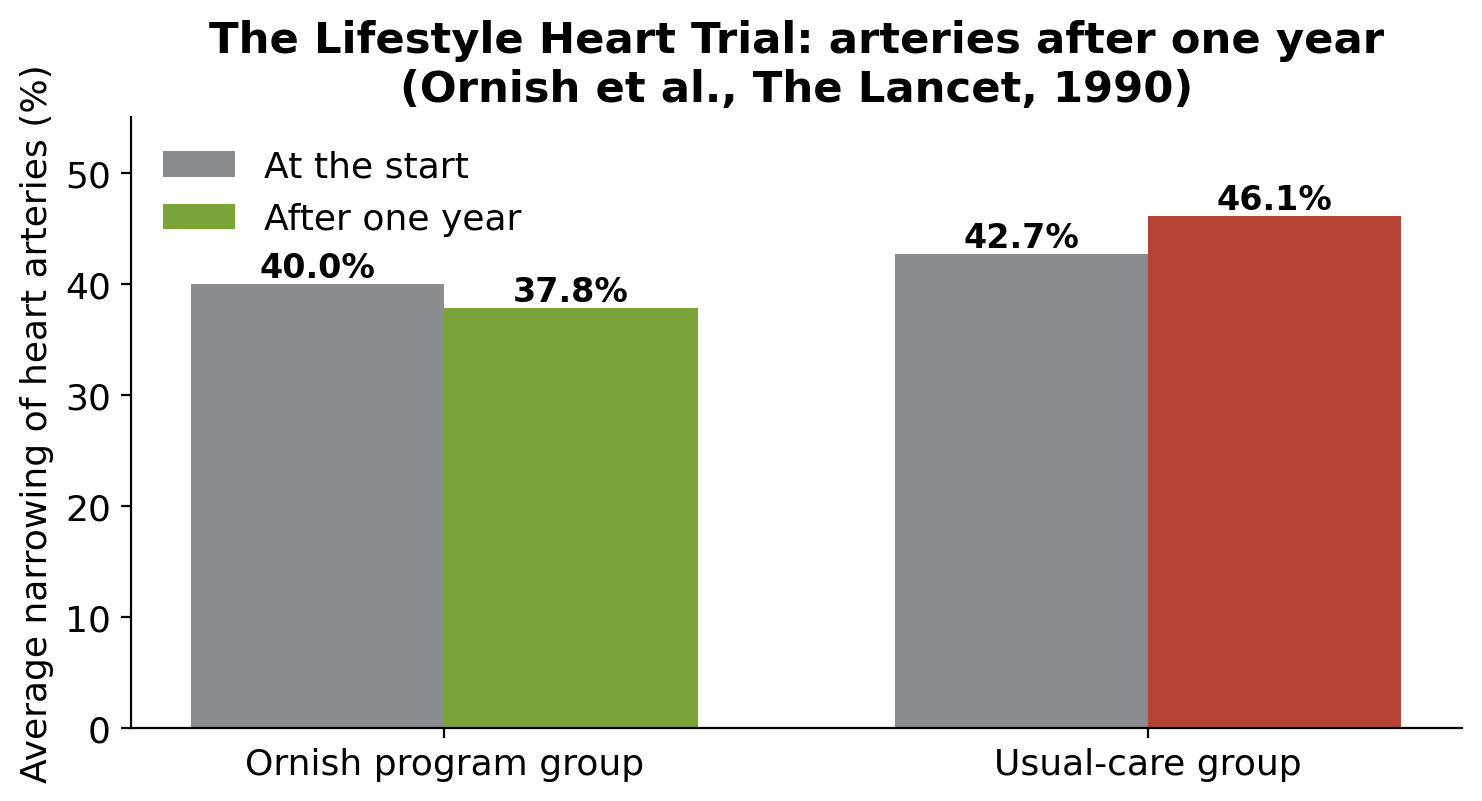
Then came the proof. In the Lifestyle Heart Trial, published in The Lancet in 1990, patients with serious heart disease were divided into a program group and a usual-care group. After one year, the average narrowing in the program group’s arteries had gone down, from 40.0% to 37.8%, while the usual-care group’s had grown, from 42.7% to 46.1%. Eighty-two percent of the program patients moved toward healing. No cholesterol-lowering drugs were used. And it held. Five years later, the program group had improved further, while the usual-care group had worsened further. The usual-care patients also suffered more than twice as many cardiac events (heart attacks and similar heart problems): 45 events among 20 people, against 25 among 28.
Reading them by our yardsticks
Proportions first. On this yardstick the pioneers score well — with one loud exception. They restored the package whole food comes in: dense in minerals, vitamins, fibre and water, with carbohydrate arriving as whole grains and vegetables rather than sugar. Against the standard diet’s 42% fat, though, they swung to under 10%. That is not a gentle correction; it is the lever pulled to the very end of its travel. Protein also lands low, though beans, grains and nonfat dairy quietly add up to more than most people expect. The honest question the yardstick asks is whether an ordinary person, in an ordinary kitchen, can live at that end of the scale for years. Both programs earned their best results in supervised settings — and both men knew it.
Balance of opposites. Here they eat almost entirely from the calm middle our yardstick points to — grains, beans, vegetables — cooling and cleansing foods rather than heating and stimulating ones. The cost of living so far to one side appears in what is missing. Very little fat means less help absorbing the fat-soluble vitamins (the old names: A, D, E and K). It also means meals that satisfy less deeply. That is one reason hunger and quiet dropout follow these programs home from the centres.
Acid and alkaline. On this yardstick they are the strongest diets in the whole series. Their plates deposit minerals into the alkaline bank all day long, and almost nothing withdraws. If the standard modern diet is the overdraft, Pritikin and Ornish are the repayment plan.
One fairness point, because it matters. The “low-fat” packaged foods that later flooded the supermarkets — fat-free cookies and snacks sweetened with sugar and refined starch — were not their diet. Both men insisted on whole, unrefined food, always. Judging Pritikin by a fat-free cookie would be like judging a swimming teacher by a drowning.
Where they stand today
Time has been kinder to these two than to most diet pioneers. Since 2010, the United States Medicare system has paid for both programs as “intensive cardiac rehabilitation” (a closely supervised heart-recovery program) for heart patients. They are two of only three programs ever approved at that level. That is as close as official medicine comes to admitting that lifestyle, done thoroughly, is itself a treatment. The Pritikin center still operates today, now in Miami, fifty years after it first opened, with more than a hundred published studies behind it. Ornish’s program is offered through hospitals and clinics across the United States. And in 2024, his team reported that the same whole program — plant-based diet, daily exercise, stress management, group support — improved thinking and daily functioning in a small trial of people with early Alzheimer’s disease. It was a small, short study, and larger ones must follow. But the direction matches what his heart patients showed a generation ago: the body responds to the whole pattern, not to one pill or one nutrient.
The mainstream, meanwhile, quietly corrected the pioneers’ one oversimplification. In 2006, a very large trial — the Women’s Health Initiative, nearly 49,000 women — found that simply eating less total fat did not, by itself, prevent heart disease or stroke. Part of the reason is instructive: the women cut the useful fats along with the harmful ones, and replaced fat with more carbohydrate, much of it refined. Official advice today no longer counts fat the way the 1970s did; it asks which fats, and what the whole plate looks like. Our yardsticks could have predicted that ending — pull any single lever to its limit, and something else quietly bends. What has survived intact is the pioneers’ core: whole plant foods at the centre of the plate, and the demonstration — photographed inside human arteries — that the body can heal when the pattern truly changes.
Where we go from here
In Part III, we meet the rivals who looked at the same modern diet and blamed the opposite suspect. Dr. Robert Atkins, and the doctors behind Protein Power, argued that fat was never the villain — carbohydrate was, and fat and protein should take its place at the centre of the plate. They produced dramatic early weight loss of their own, and their feud with the low-fat camp shaped thirty years of argument about food. With our yardsticks in hand, we will be able to see what the low-carb rebellion got right, where it pulls the balance too far the other way — and why the truth was never going to fit on either side’s banner.
This information is provided/written by David Chan, CNP, ROHP, and is educational only — it is not intended to replace the medical advice of your doctor. Please consult your doctor for advice about a specific medical condition.