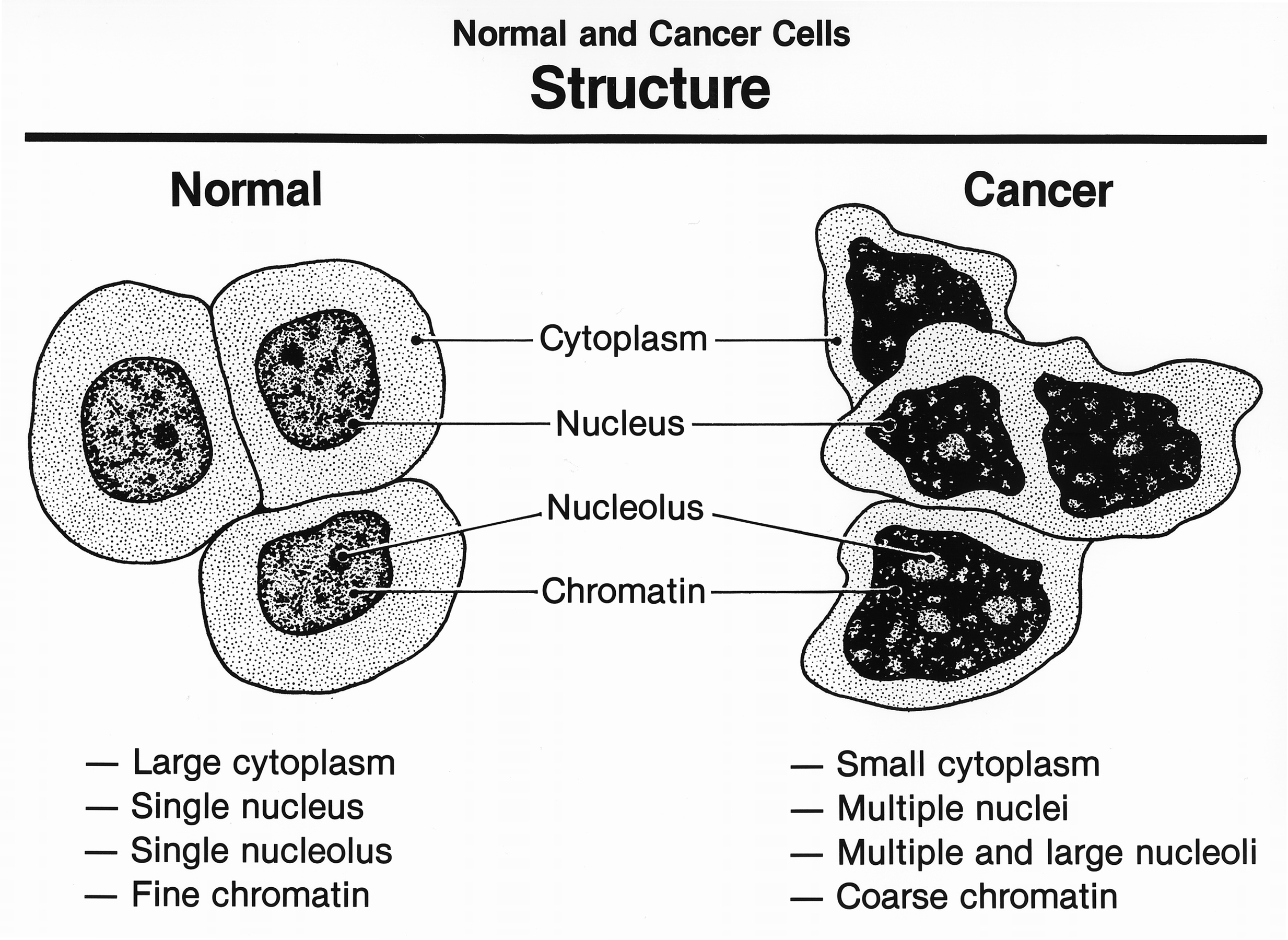
Cancer is not one disease. It is a large family of diseases, and they are grouped into types. Knowing the types helps you understand any cancer news you hear — and any diagnosis in a family — in plain terms.
What cancer is, in plain words
Your body is always replacing old cells with new ones. Healthy cells grow, do their work, and die on schedule. Cancer begins when a cell’s instructions are damaged and it stops following that schedule: it keeps dividing when it should stop, and the new cells it makes carry the same fault.
Tumours: benign and malignant
A lump of extra cells is called a tumour.
- A benign tumour is not cancer. Its cells look much like healthy tissue. It stays in one place, does not spread, and often grows slowly or stops. It can still cause trouble if it presses on something important, so doctors watch or remove some of them.
- A malignant tumour is cancer. Its cells can grow into nearby tissue, and they can break away and travel through the blood or the lymph system to start new tumours in other parts of the body. When cancer spreads this way, doctors call it metastasis. The first tumour is the primary site; the new ones are secondary tumours. A breast cancer that spreads to the bone is still breast cancer — it is named for where it started.
Not every cancer forms a lump. Leukaemia, below, grows in the blood and bone marrow and usually forms no solid tumour at all.
The main families
There are more than 200 types of cancer. Most fall into these families, named for the kind of cell where the cancer starts:
- Carcinoma — the most common family. It starts in the skin, or in the tissue that lines or covers organs. Lung, breast, prostate, colon and ovarian cancers are usually carcinomas.
- Sarcoma — starts in the body’s support tissues: bone, cartilage, fat, muscle and other connective tissue. Sarcomas are much less common than carcinomas.
- Leukaemia — starts in the blood-forming tissue of the bone marrow. The marrow pours out large numbers of abnormal blood cells, which crowd out the healthy ones.
- Lymphoma — starts in the lymph system, the network of vessels and nodes that is part of the immune system. The two main kinds are Hodgkin lymphoma and non-Hodgkin lymphoma.
- Multiple myeloma — starts in plasma cells, a kind of white blood cell in the bone marrow that normally makes antibodies to fight infection.
- Brain and spinal cord cancers — start in the central nervous system. They are grouped by the kind of brain cell involved, and even a slow-growing one can be serious because the skull leaves no room to spare.
- Skin cancers — most start in the skin’s surface cells and are carcinomas. Melanoma, which starts in the pigment-making cells, is less common but more likely to spread, which is why changing moles deserve a prompt check.
How doctors group cancers today
The family names above are still the starting point. Today, doctors also test the tumour’s genes. Two cancers that look the same under the microscope can carry different gene changes — and those changes can decide which drug or treatment is most likely to help. So a modern diagnosis names three things together: where the cancer started, its family and stage (how far it has gone), and, more and more often, its gene pattern.
Cancer in Canada today
Cancer touches almost every family. About 2 in 5 Canadians will be diagnosed with cancer in their lifetime. An estimated 247,100 new cases were expected in Canada in 2024, and four cancers — lung, breast, prostate and colorectal — together make up almost half of them. Lung cancer causes more cancer deaths than any other type. (Source: Canadian Cancer Statistics 2024, Canadian Cancer Society with Statistics Canada and the Public Health Agency of Canada.)
Those numbers are the reason this simple map of types is worth knowing: when research, screening or a new treatment is in the news, it is almost always about one family, one body part, or one gene pattern — not about “cancer” as a single thing.
A closing word
This page is a map, not medical advice. If you find a lump, a sore that does not heal, or any change that lasts, see your doctor promptly — early care gives the best choices, whatever the type turns out to be. Food, rest and a healthy way of living support your body through every season of health, but they do not replace diagnosis or treatment, and this site makes no claim that they do.
Keep reading on Genesis Health: “Why Cancer – A Non-Conventional Belief that Cancer can be Triggered by Emotional Conflict — Parts One and Two”
This information is provided/written by David Chan, CNP, ROHP, a very experienced Holistic Nutritionist who has consulted clients for over 15 years. It is educational only — it is not intended to replace the medical advice of your doctor. Please consult your doctor for advice about a specific medical condition. Genesis Health provides education and serves existing private clients only. © Copyright Genesis Health Inc. All rights reserved.